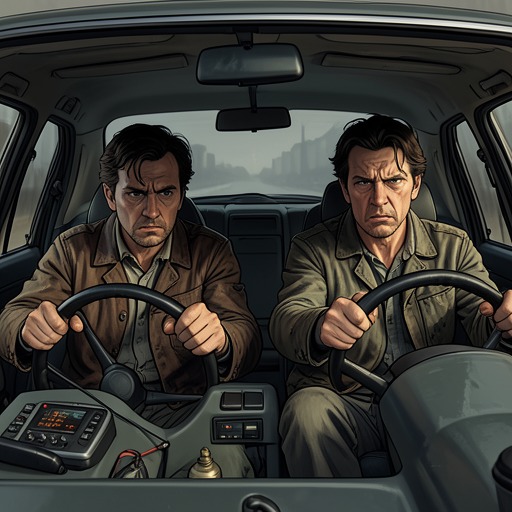
Jim and Jack drive to visit his estranged daughter
Anxious PeopleJim and Jack drive to visit his estranged daughter in an attempt to bring her home. Their journey follows years of missed reunions, addiction, and grief: Jack has stopped expecting his sister to return, while Jim continues to hope. The trip does not promise a reconciliation or a cure. Its significance lies in the choice to go together and ask again, despite knowing they cannot control the answer.
Background and Family History
Jim’s daughter is seven years older than Jack. When she was young, Jim imagined children as kites and himself holding the string; eventually, she pulled free. Her substance use became a source of repeated family distress, though Jim habitually described her as ill while Jack named her addiction directly. Their different language reflects different ways of bearing the same fear: Jim tries to preserve hope, and Jack is more alert to the possibility of loss.
Several years before the drive, Jack withdrew the savings he had intended to use toward buying an apartment to pay for his sister’s treatment at an exclusive private clinic. He drove her there. She checked herself out after two weeks, by which time the money could not be recovered. Six months later, she phoned in the middle of the night and asked for money for a plane ticket home. Jack sent it; she never came. The episode sharpened the difference between father and son: Jim kept pursuing his daughter like a kite still visible in the sky, while Jack had stopped running after her.
The estrangement deepened after Jim’s late wife and Jack’s mother died. Jack called his sister and sent money for her flight, but she did not attend the funeral. Jim and Jack continued sending money whenever she called, often on the promise that she would come home. Their mother, a priest who had offered care to others, remains a bond between the men even after her death. Their grief is not identical: Jim hopes that an unfamiliar phone number may bring news of his daughter, while Jack fears that such a call may tell him she is dead. Both carry the questions of what a family can do for someone it cannot make well.
The Decision to Go
Near the close of the story, Jack proposes that they pick up his car from the station and go for a drive. When Jim asks where, Jack says they should visit his sister. Jim is surprised that Jack means to go now, and asks why the trip cannot wait. Jack points to the approaching birthdays—his sister’s and Jim’s—and to the fact that Christmas is only eleven months away. He argues that the precise reason should not matter: perhaps she would like to come home.
The proposal reverses their familiar positions. Jim has been the one to hope aloud each winter that his daughter might return for Christmas; Jack has usually answered in a way that lets his father keep that hope without correcting him. Now Jack initiates the visit himself. His decision does not erase his earlier efforts or their disappointments. Rather, it shows that having stopped chasing his sister is not the same as ceasing to care for her.
The Journey and Its Uncertain Outcome
Jim notes that the drive will take at least twenty-four hours. Jack responds that they have already agreed to stop for coffee. They set off, driving through the night and the following day, then knock on his sister’s door. The account does not say whether she answers or whether she agrees to go home with them. It leaves the central outcome open: she may be ready to find a safer way forward, or she may not be.
That uncertainty is not a failure of the journey but its condition. Jim and Jack can make the drive and offer their company; they cannot decide for her what she will do. The trip places them side by side in an effort neither can guarantee will succeed. In that respect, it differs from Jack’s earlier attempt to pay for treatment or buy a plane ticket: those acts were also attempts to help, but this time father and son go together and leave the response to her.
Meaning of the Visit
The drive brings the book’s recurring contrast between flying and falling into the family’s immediate future. The family cannot control whether the daughter will return or find a better way down, any more than it can control the risks that accompany addiction. What it can choose is whether to make another attempt at contact. Jack’s invitation gives Jim a companion in that effort, while Jim’s willingness to go means he does not have to carry his hope alone.
The ending also connects the visit to the ethic left by Jim’s late wife: do one’s best even when the future cannot be secured. The journey offers no neat resolution and no proof that the family’s next attempt will work. It closes instead on action under uncertainty: Jim and Jack knock on the door, making room for the possibility of a homecoming without claiming that love can control its outcome.